0. Quick Overview
ISO 29463 is the internationally valid standard for high-efficiency particulate air filters (EPA, HEPA, ULPA). It defines 13 filter classes from ISO 15E to ISO 75U, covering filtration efficiencies from 95 % to 99.999995 %. Classification is always based on the particle size at which the filter shows its lowest arrestance – the so-called MPPS (Most Penetrating Particle Size). ISO 29463 coexists with the European standard EN 1822:2019, which retains the familiar classes H13, H14 and U15–U17, but whose test procedures (Parts 2–5) now refer entirely to ISO 29463.
Current editions of the standard:
| Standard / Part | Content | Current Edition |
|---|---|---|
| ISO 29463-1 | Classification, performance testing, marking | 2024 (3rd revision, Aug. 2024) |
| ISO 29463-2 | Aerosol generation, measuring equipment, particle-counting statistics | 2018 |
| ISO 29463-3 | Testing of flat sheet filter media | 2018 |
| ISO 29463-4 | Leakage testing – scan method | 2018 |
| ISO 29463-5 | Test method for filter elements (MPPS efficiency) | 2018 |
| EN 1822-1 | Classification, testing, marking (European parallel classes E10–U17) | 2019 |
1. History and Background: From MIL-STD-282 to ISO 29463
HEPA filters were developed in the late 1940s – originally to protect against the spread of radioactive particles in the context of the Manhattan Project and for military gas masks. The theoretical foundations of particle separation mechanisms (diffusion, inertial impaction, interception, electrostatic attraction) had been understood since around 1900; translating that knowledge into high-efficiency filter elements with measurable, reproducible performance came later.
The first standardised test method appeared in 1956 as the American military standard MIL-STD-282 – it remains normatively anchored in many safety-critical sectors in the USA to this day. In Europe, EN 1822 was introduced in 1998, establishing for the first time a performance-based classification system grounded in the MPPS principle. Japan developed the parallel standard JIS B 9927. The incompatibility of these national standards – differing test aerosols, differing classification concepts, no mutual recognition – caused significant problems in cross-border supply chains, particularly in the pharmaceutical and semiconductor industries.
ISO 29463 addresses this issue. Its development began under ISO TC 142 (Cleaning Equipment for Air and Other Gases). Parts 1–5 were first published in October 2011, revised in 2017/2018, and Part 1 was most recently updated in August 2024. The goal is not to replace national standards, but to establish a common reference framework for classifications and test methods.
2. The MPPS Principle – Why 0.3 µm Is Not Always the Critical Size
The concept of the Most Penetrating Particle Size (MPPS) is the most important distinction between modern high-performance filter standards and older test methods. Air filters capture particles through several physical mechanisms:
| Separation Mechanism | Effective For | Efficiency at Small Particle Sizes |
|---|---|---|
| Inertial impaction | Large particles > approx. 1 µm | Low |
| Interception | Medium particles ~0.5–2 µm | Medium |
| Diffusion (Brownian motion) | Very small particles < approx. 0.3 µm | High (increases as size decreases) |
| Electrostatic attraction | All sizes (media-dependent) | Variable, not reliably durable |
The interaction of these mechanisms creates an efficiency minimum – the MPPS – typically in the range of 0.1 to 0.3 µm. A HEPA filter achieving 99.97 % arrestance at 0.3 µm will generally perform even better for both smaller and larger particles. The historical choice of 0.3 µm as the test particle size was a practical compromise – MPPS-based testing is physically more precise and delivers the true worst-case efficiency of the filter.
Both ISO 29463 and EN 1822 determine the MPPS individually for each filter type and classify based on the efficiency measured at exactly that point. This is more demanding, but more honest than fixing an arbitrary test particle size.
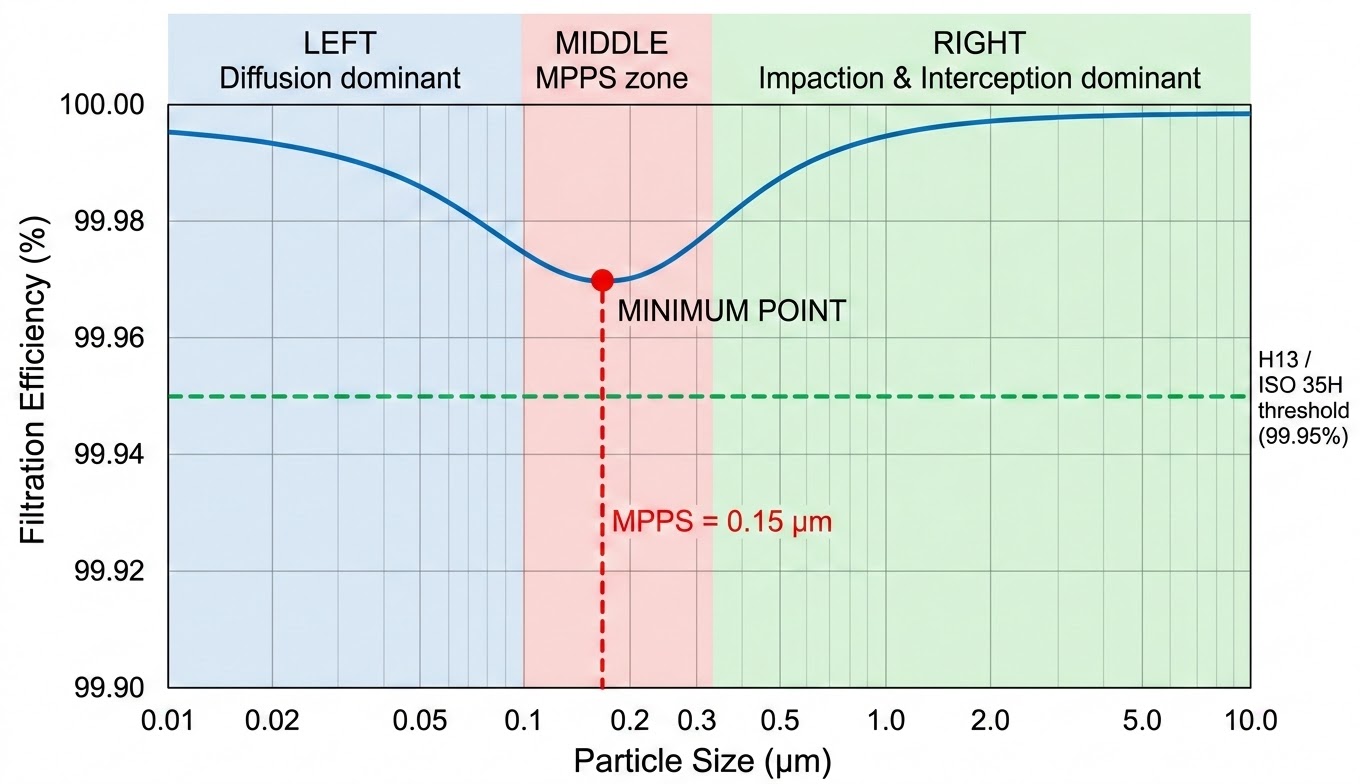
The MPPS efficiency curve of a HEPA filter: filtration efficiency reaches its minimum at approximately 0.15 µm – the Most Penetrating Particle Size. Below the MPPS, diffusion is the dominant capture mechanism; above it, impaction and interception take over. The green dashed line marks the H13 / ISO 35H classification threshold at 99.95 %. A filter passes this class only if its efficiency at the MPPS remains above this threshold.
3. Structure of ISO 29463 in Detail
Part 1: Classification, Performance Testing and Marking (ISO 29463-1:2024)
Part 1 defines the complete classification system with 13 classes in three groups (E, H, U), as well as requirements for marking and test documentation. The third revision of August 2024 primarily refines the requirements for global comparability and closes gaps in the integration of additional national test methods, including those from the Asia-Pacific region.
Filters in group E (EPA) are classified by statistical sampling; H and U filters are tested individually – each filter element receives its own test certificate stating integral efficiency and local penetration (scan test).
Filter classes according to ISO 29463 and comparison with EN 1822:
| ISO 29463 Class |
Group | Integral efficiency (overall arrestance) |
Max. local penetration |
EN 1822 Equivalent |
|---|---|---|---|---|
| ISO 15 E | E (EPA) | ≥ 95 % | – | E11 |
| ISO 20 E | E (EPA) | ≥ 99 % | – | E12 |
| ISO 25 E | E (EPA) | ≥ 99.5 % | – | – (between E12 / H13) |
| ISO 30 E | E (EPA) | ≥ 99.9 % | – | H13 |
| ISO 35 H | H (HEPA) | ≥ 99.95 % | ≤ 0.25 % | H13 |
| ISO 40 H | H (HEPA) | ≥ 99.99 % | ≤ 0.05 % | H14 |
| ISO 45 H | H (HEPA) | ≥ 99.995 % | ≤ 0.025 % | H14 / U15 |
| ISO 50 U | U (ULPA) | ≥ 99.999 % | ≤ 0.005 % | U15 |
| ISO 55 U | U (ULPA) | ≥ 99.9995 % | ≤ 0.0025 % | U16 |
| ISO 60 U | U (ULPA) | ≥ 99.9999 % | ≤ 0.0005 % | U16 / U17 |
| ISO 65 U | U (ULPA) | ≥ 99.99995 % | ≤ 0.00025 % | U17 |
| ISO 70 U | U (ULPA) | ≥ 99.99999 % | ≤ 0.0001 % | – |
| ISO 75 U | U (ULPA) | ≥ 99.999995 % | ≤ 0.0001 % | – |
Important note on class equivalence: The mapping between ISO 29463 and EN 1822 is not always a clear 1:1 relationship. An EN 1822 H14 filter (integral efficiency ≥ 99.995 % at MPPS) corresponds under ISO 29463 logic to class ISO 45 H – and is consequently classified as ULPA-equivalent. Critically, ISO 29463 has no equivalent for EN 1822 class E10. That class (85–95 % efficiency) falls within the scope of ISO 16890 (ISO ePM1 >95 %).
Part 2: Aerosol Generation, Measuring Equipment and Particle-Counting Statistics (ISO 29463-2:2018)
Part 2 specifies the test aerosols and measuring instruments for efficiency and leakage testing. Permitted test aerosols include liquid paraffin or DEHS aerosols, PAO (polyalphaolefin) and PSL particles (polystyrene latex). This part also establishes the statistical framework for particle-counting procedures where event numbers are very small – a practically important issue for ULPA filters at the U16/U17 level, where the particle count in the clean-air stream is extremely low and statistical confidence requires careful methodology.
Part 3: Testing of Flat Sheet Filter Media (ISO 29463-3:2018)
Part 3 defines the test procedures for the raw filter medium as a flat sheet specimen, before it is processed into a finished filter element. Media testing provides manufacturers with key input data for quality assurance and for the design of pleating geometry and packing density. However, media testing alone is not sufficient for EN 1822 classification of the finished filter – the complete assembled element must be tested individually.
Part 4: Leakage Testing – Scan Method (ISO 29463-4:2018)
The scan method is the reference method for verifying the leak-tightness of HEPA and ULPA filter elements. An aerosol detector systematically traverses the entire filter surface – filter medium, frame and seal – measuring local penetration values. Even the smallest defects, such as broken fibres, pinholes in the medium, faulty frame bonding or seal-seat failures, are reliably detected.
Part 4 applies to classes ISO 35H through ISO 75U. For HEPA classes ISO 35H to ISO 45H, the standard additionally describes two further normative methods: the oil thread leak test (traditional, visual) and the photometer leak test (fast, suitable for large filters in production environments). Testing with solid PSL aerosol particles is also described. EN 1822-1:2019 sets a higher bar than ISO 29463 in this area – it explicitly prohibits the use of aerosol photometers and mandates the scan test exclusively for H and U class filters.
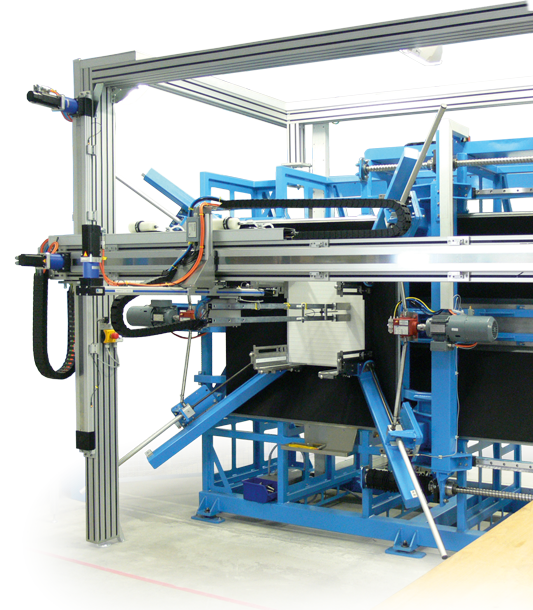
The scan test rig at HS-Luftfilterbau GmbH enables non-destructive individual testing of every HEPA and ULPA filter – from standard 610×610 mm elements to custom dimensions for cleanrooms, offshore platforms and nuclear power plants.
Part 5: Test Method for Filter Elements – MPPS Efficiency (ISO 29463-5:2018)
Part 5 defines the reference procedure for determining both integral and local efficiency of the finished filter element at the MPPS. The standard provides supplementary test guidelines for filters with an MPPS below 0.1 µm, and for filter media made from charged synthetic fibres (electret media), whose arrestance can decrease over time as the electrostatic charge dissipates under operating conditions.
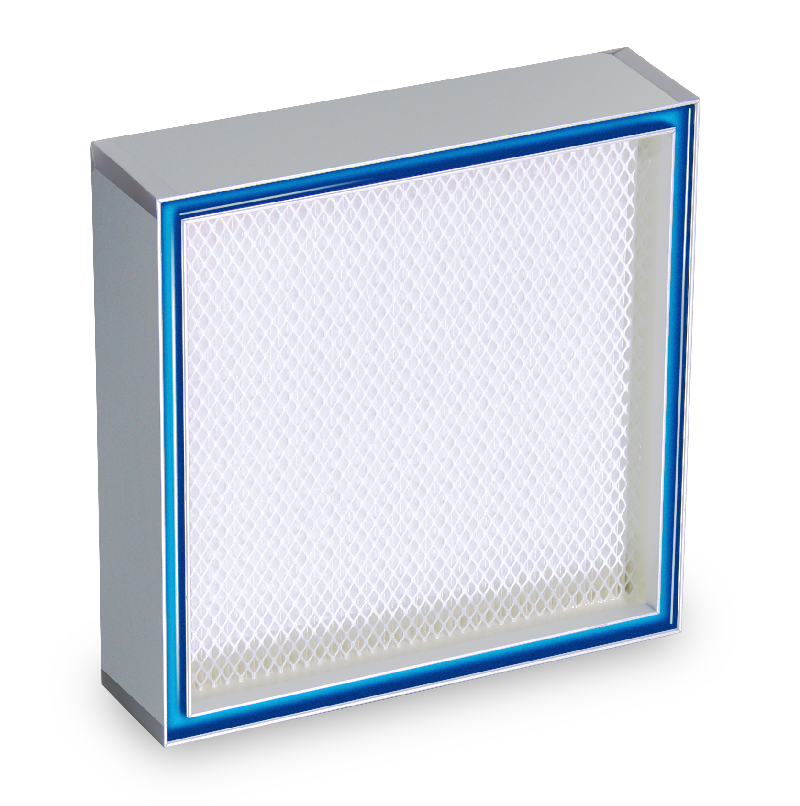
Shown: HS-Mikro SF-AL HEPA filter with gel seal – for cleanrooms, GMP facilities and pharmaceutical projects, certified to EN 1822 / ISO 29463. Details at www.luftfilterbau.de.
4. ISO 29463 and EN 1822 – Coexistence, Not Competition
A common question: does ISO 29463 replace EN 1822? The answer is: no – at least not entirely. The relationship is nuanced:
- EN 1822-1:2019 (classification) remains valid and retains the established classes E10–E12, H13–H14, U15–U17. These designations are firmly embedded in specifications, tender documents and regulatory requirements (GMP, cleanroom standards, nuclear regulations) worldwide.
- ISO 29463-2 to -5 fully replace the test procedure parts 2–5 of the old EN 1822. In practice this means: EN 1822 classification, but testing performed according to ISO 29463 methodology.
- ISO 29463-1:2024 defines an independent classification system with 13 levels. This is primarily used in global contexts – the USA, Japan, Southeast Asia – where EN 1822 class designations are less familiar.
In European practice, EN 1822 classes continue to dominate. H13 and H14 are the most frequently referenced filter classes in GMP guidelines, VDI standards and cleanroom specifications. ISO 29463 offers the advantage that test certificates can be compared globally without any standard conversion.
5. Applications: Where HEPA and ULPA Filters to ISO 29463 / EN 1822 Are Required
| Application | Typical Class | Relevant Standard / Regulation |
|---|---|---|
| Pharmaceutical production (sterile manufacturing, filling lines) | H14 (ISO 40H) | EU GMP Annex 1, ISO 14644-1 |
| Cleanrooms ISO Class 1–5 (semiconductor, optics) | U15–U17 (ISO 50U–ISO 65U) | ISO 14644-1/-3 |
| Cleanrooms ISO Class 5–8 (general) | H13–H14 (ISO 35H–ISO 40H) | ISO 14644-1, VDI 2083 |
| Operating theatres, intensive care units | H13–H14 (ISO 35H–ISO 40H) | DIN 1946-4, HTM 03-01 (UK) |
| Nuclear technology / radioactive filtration | H13–H14, special requirements | KTA 3601, IAEA standards |
| Offshore wind / gas turbine intake air | E11–H14 (depending on stage) | ISO 29463, ISO 16890, ISO 10083 |
| Biosafety laboratories BSL-3 / BSL-4 | H14 (ISO 40H–ISO 45H) | WHO Laboratory Biosafety Manual, EN 12469 |
| Microelectronics / lithography processes | U16–U17 (ISO 55U–ISO 65U) | ISO 14644-1, SEMI standards |
HS-Luftfilterbau GmbH supplies HEPA and ULPA filters for all of the above application fields – from standard deliveries to highly customised solutions for offshore platforms, pharmaceutical isolators and nuclear facilities. More at www.luftfilterbau.de.
6. The Boundary Below: ISO 29463 and ISO 16890
ISO 29463 (and EN 1822) begin where ISO 16890 ends. The boundary in detail:
- ISO 16890 governs particulate air filters for general ventilation – from ISO Coarse up to ISO ePM1 (>95 %), which broadly corresponds to EN 1822 E10.
- ISO 29463 starts at ISO 15E (≥ 95 %), equivalent to EN 1822 E11 (≥ 95 % at MPPS). ISO 29463 has no equivalent for E10.
- For E10-level requirements (85–95 % at MPPS), EN 1822-1 is the governing standard – this range is outside the scope of ISO 29463.
Multi-stage ventilation and air conditioning systems therefore typically combine ISO 16890-classified pre-filters (pocket filters, compact filters) with a final HEPA stage to EN 1822 / ISO 29463. HS-Luftfilterbau GmbH designs and supplies both stages from a single source – from ISO ePM1 pocket filters to U17 high-efficiency filters.
7. Individual Testing and Test Certificates – Why Every Filter Is Unique
A defining characteristic of HEPA and ULPA filters: they are not batch-sampled, but tested individually and non-destructively. Every filter element of class ISO 35H and above (H and U groups) receives its own test certificate documenting:
- Integral efficiency (overall arrestance at MPPS)
- Local penetration (scan test: maximum value across the entire filter face)
- Pressure drop at rated airflow
- Serial number and batch assignment
This test certificate accompanies the filter throughout its entire service life. It forms the basis for in-situ tests carried out on site – for example in pharmaceutical facilities under GMP Annex 1, or in nuclear power plants under KTA 3601 – where the installed filter is verified for leak-tightness in its installed condition. Filters without a complete individual test certificate may not be used in these regulated environments.
HS-Luftfilterbau GmbH tests every HEPA and ULPA filter in its own in-house laboratory in Kiel to EN 1822 / ISO 29463. Test records are archived digitally and are available on request for audits and regulatory submissions.
8. Related Standards and Regulations
ISO 29463 and EN 1822 do not stand in isolation – they are embedded in a broader network of standards:
| Standard | Topic / Relation to ISO 29463 |
|---|---|
| ISO 16890 | Pre-filters and general ventilation – the stage below HEPA; ISO ePM1 up to approx. 95 % |
| ISO 14644-1/-3 | Cleanroom classification ISO 1–9; Part 3 defines requirements for filter testing in installed condition |
| EU GMP Annex 1 (2022) | Requirements for sterile manufacturing in the pharmaceutical industry; filter classes H13/H14 explicitly mandated |
| KTA 3601 | German nuclear safety rule for ventilation systems in power plants; specific requirements for HEPA filters and in-situ testing |
| DIN 1946-4 / HTM 03-01 | Ventilation systems in hospitals (German / UK); requirements for operating theatre and critical care environments |
| VDI 2083 | Cleanroom technology; comprehensive German guideline for design, construction and operation of cleanrooms |
| MIL-STD-282 (USA) | Historic US military standard; still the normative basis for many regulated US applications |
| JIS B 9927 (Japan) | Japanese HEPA/ULPA standard; increasingly harmonised through ISO 29463 |
| EN 12469 | Performance criteria for microbiological safety cabinets; H14 filters required for Class II and III cabinets |
HEPA & ULPA Filters up to ISO 75 U
HS-Luftfilterbau GmbH manufactures EPA, HEPA and ULPA filters to EN 1822 and ISO 29463 in classes E10 to U17 (ISO 15E to ISO 75U). Shown: HS-Mikro SF-AL with gel seal – for pharmaceutical cleanrooms, isolators and offshore installations.
- HEPA & ULPA Filters – HS-Luftfilterbau
- Cleanroom & Pharma Applications
- ISO 16890 – Pre-filters & General Ventilation
- Fundamentals of Air Filtration
- ISO 29463-1:2024 at ISO.ORG
- EN 1822 at DIN Media
- Request test certificates & consultation
Further Information
Scan Test Rig EN 1822 / ISO 29463
Every HEPA and ULPA filter is tested individually and non-destructively in our in-house laboratory – for integral efficiency, local leakage and pressure drop. The test certificate accompanies the filter through to the in-situ test on site.
HS-Luftfilterbau GmbH
Leading manufacturer of air filters for HVAC, ventilation and cleanroom technology, based in Kiel, Germany. In-house ISO 16890 and EN 1822 / ISO 29463 test laboratory. Certified to ISO 9001, ISO 14001 and KTA 3601.
- HEPA/ULPA E10–U17 to EN 1822
- ISO 29463 classes ISO 15E to ISO 75U
- Pocket filters ISO ePM1 up to 85 %
- Compact filters up to ISO ePM1 95 %
- Custom filters for offshore, pharma & nuclear